Legacy
What to put in an "if something happens to me" folder
An “if something happens to me” folder holds what your family will need in the first days: a one-page letter saying who to call and where things are, your contacts, an account list, how to get into your devices and accounts, copies of key documents, and your wishes. Keep a paper version in one known place and an encrypted digital copy, and tell 2 people where both are.
It’s not a will. It’s the map your family uses to find the will, the policies and everything else, at a time when they won’t be thinking clearly. A good folder saves them weeks.
This is general information, not legal advice. The folder doesn’t decide who inherits anything; your will does. A lawyer, such as James Miller in our examples, can make sure the two agree.
Page 1: the letter
Start with one page your family can read in 2 minutes:
- Who to call first, with numbers: usually your executor and your lawyer.
- Where the will is, and where the original is if this folder has a copy.
- What’s urgent: a pet to feed, a mortgage payment due on the 1st, an employer to tell.
- Where everything else is, by section.
- The date you last updated it.
Write it plainly and kindly. They’ll read it more than once.
Section 2: people
- Lawyer and executor
- Accountant or tax preparer, financial adviser
- Employer and HR contact, for pay, pension and life insurance through work
- Insurers, with policy numbers
- Doctor
- Close friends who should be told, and anyone who shouldn’t be the one to handle certain things
Section 3: the account list
A table of every bank, investment, retirement, pension, loan, credit card and insurance account. For each: the institution, the account type, the last 4 digits and a phone number.
Never full account numbers, PINs or passwords on paper in this folder. A folder is easy to find, and that’s the point; it shouldn’t also be easy to empty your accounts with.
Section 4: how to get in
Your family can’t open your iPhone without its passcode, and some accounts can’t be opened at all without the right setup. Note where each key is, not the key itself:
- Devices: “Passcodes for my iPhone and Mac are in a sealed envelope with James Miller.” See how to give your family access to your iPhone.
- Apple Account: who your Legacy Contact is, and where the printed access key is. See Apple Legacy Contact.
- Passwords: which password manager, and how it passes on (emergency access, an Emergency Kit, a shared group). See password manager emergency access.
- Crypto: that it exists, and where the instructions are. See passing on crypto wallet recovery.
- Bunker vaults: which vaults matter, and who holds Legacy Cards. Not the cards themselves, and not a Recovery Phrase.
Section 5: copies of documents
Copies, with the location of each original:
- will and trust documents;
- power of attorney and healthcare directive;
- life, home, car and health insurance policies;
- deeds, mortgage papers and vehicle titles;
- birth and marriage certificates, passports;
- pension statements and the last 2 years of tax returns.
Where to keep important documents covers where the originals should live.
Section 6: wishes and letters
- Funeral wishes: burial or cremation, religious or not, music, who should speak
- Organ donation
- Care for pets, with the vet’s number
- Who should get things of sentimental value (your will should say this too, if it matters legally)
- Letters to the people you love
What stays out
- Passwords, PINs and full account numbers
- Seed phrases and Bunker Recovery Phrases
- Legacy Cards (each one goes to its own trusted contact)
- The original will, unless your lawyer agrees this is the place for it
Paper, digital, or both
The paper folder is what your family will reach for first. Keep it in one known place, such as a fire-resistant box at home or with your lawyer, and tell 2 people where it is.
The digital copy protects against fire and distance, and lets your family search it. It holds the same sensitive details, so it needs to be encrypted, and the right people need to be able to open it.
That’s what a Bunker Legacy Vault is for. Scan the folder into a vault with the Document Scanner, which reads the text on your device so it can be searched. With Bunker Pro, make the vault a Legacy Vault: choose up to 5 trusted contacts and how many must come together, for example any 2 of 3. Each gets a printed Legacy Card. A card alone opens nothing, unless you chose a set of just 1. Together, enough cards open a read-only copy of that one vault, which they can export; your other vaults are never included. Bunker also suggests a letter to your trusted contacts inside the vault, which can be your page 1.
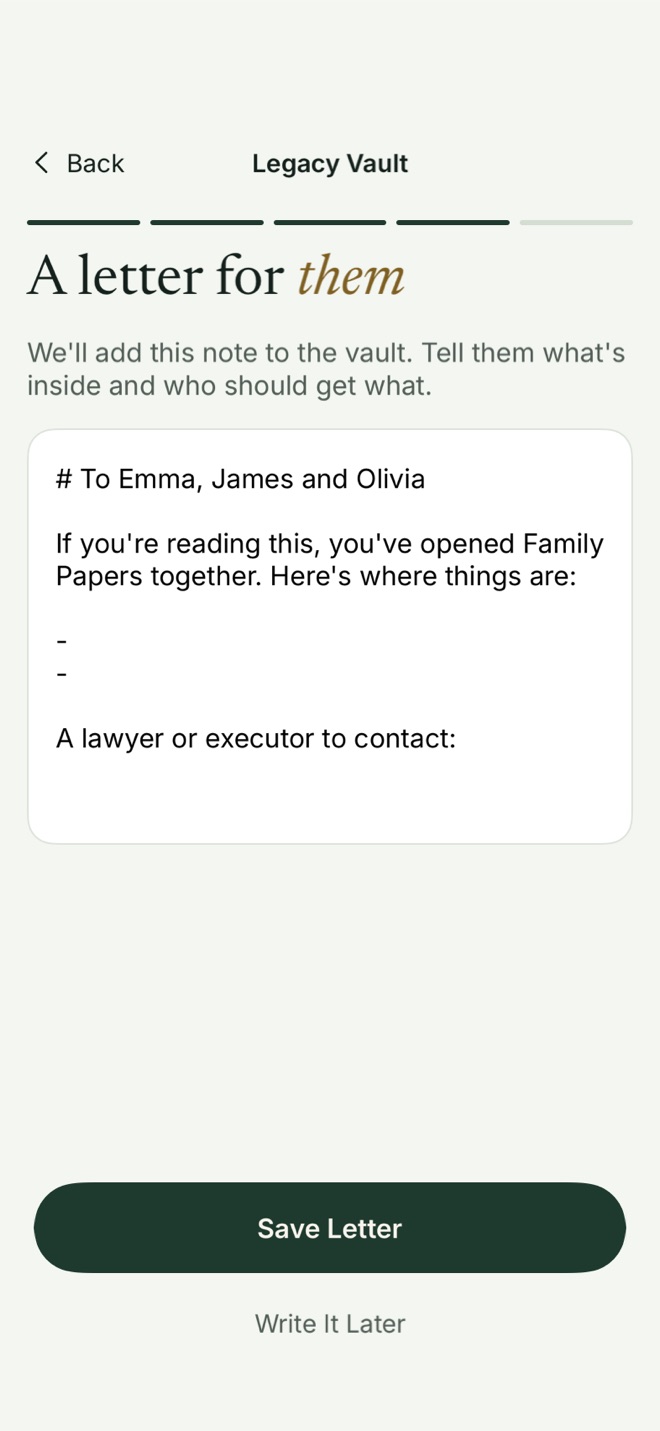
Two things to know. Bunker can’t know whether you have died: in this version, enough trusted contacts acting together can open a Legacy Vault at any time, including while you’re alive. Bunker usually lets your devices know afterwards, but that’s best-effort, and a waiting period is planned, not built. And you don’t need Bunker for this at all if a paper folder and a trusted lawyer suit your family. Plenty of good plans are a single envelope.
An example
Sarah’s paper folder is in a fire-resistant box in her hall closet, and her lawyer, James Miller, has a copy. Page 1 says to call James first and that her cat needs feeding twice a day. Her scanned copy is in a Bunker vault called “Family Papers”, a Legacy Vault that any 2 of Emma Clarke, Olivia Bennett and James can open. Section 4 says where her passcode envelope is and that Emma, Olivia and James each hold a Legacy Card. She updates it every year on her birthday, Mar 14, and the date is on page 1.
Keep it current
Review it once a year and after big changes: a move, a new job, a new bank, a marriage or divorce, a new grandchild. Bunker reminds you once a year to review a Legacy Vault; use that as the cue for the paper folder too. The digital estate planning checklist and the interactive digital legacy checklist help you check nothing’s missing.